Play NES Games Online
The Nintendo Entertainment System shelf is lit up and ready — every game here boots straight in your browser, no downloads, no dust. Nintendo hardware from 1985, running for real.
It was Nintendo's first programmable home console, succeeding the Color TV-Game line of dedicated consoles, and primarily competed with Sega's Master System in the third generation of video game consoles. It was released as the Family Computer (Famicom) in Japan on July 15, 1983, and as the NES in test markets in the United States on October 18, 1985, followed by a nationwide launch on September 27, 1986.
Top Scores — Insert Coin to Challenge
The NES Story
A 1989 corporate report later acknowledged, "In the initial stages of [the system's] development, we foresaw these possibilities... we built a data communications function into the system." Lead engineer Masayuki Uemura credited luck for this foresight, while colleague Genyo Takeda remarked that Uemura's lack of experience allowed him to attempt what others might have deemed unfeasible. Careful design attention was paid to the cartridge connectors, as loose and faulty connections often plagued arcade machines. At Gunpei Yokoi's suggestion, a cartridge eject lever was also added, not for functionality, but to amuse children.
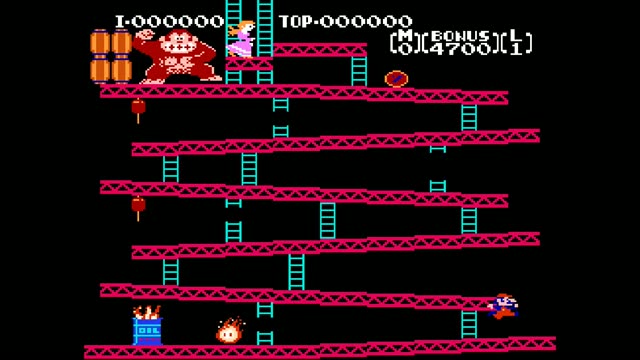
A 15-pin expansion port was added to the front of the console so that an optional arcade-style joystick could be used. It was discontinued in North America on April 13, 2017, followed by the rest of the world on April 15, 2017. The team, wanting to surpass the ColecoVision and match the more powerful Donkey Kong arcade hardware, took a Donkey Kong arcade cabinet to chip manufacturer Ricoh for analysis, which led to Ricoh producing the Picture Processing Unit (PPU) chip for the Famicom.
Why the NES Still Hits
Nintendo chose the name "Nintendo Entertainment System" for the US market and redesigned the system so it would not give the appearance of a child's toy. The original NES controller has become one of the most recognizable symbols of the console. Compute! reported in 1989 that Nintendo had sold seven million NES systems in 1988 alone, almost as many as the number of Commodore 64s sold in that system's first five years on the market.
By 1990, the NES had outsold all previously released consoles worldwide. In the wake of ever decreasing sales and the lack of new games, Nintendo of America officially discontinued the NES in 1995. thumb|The Famicom game console was at the Computer and Video Game Console Museum of [[Helsinki in 2012.]] The NES was released two years after the video game crash of 1983, when many retailers and adult consumers regarded electronic games as a passing fad, so many believed at first that the NES would soon fade.
How NES Games Run Here
These NES games run through the fceumm core directly in the browser, so what you play IS the original code — not a remake. There is no download and no setup; press play, and keyboards, gamepads and touch controls are detected automatically. Sign up free and save states travel with you.